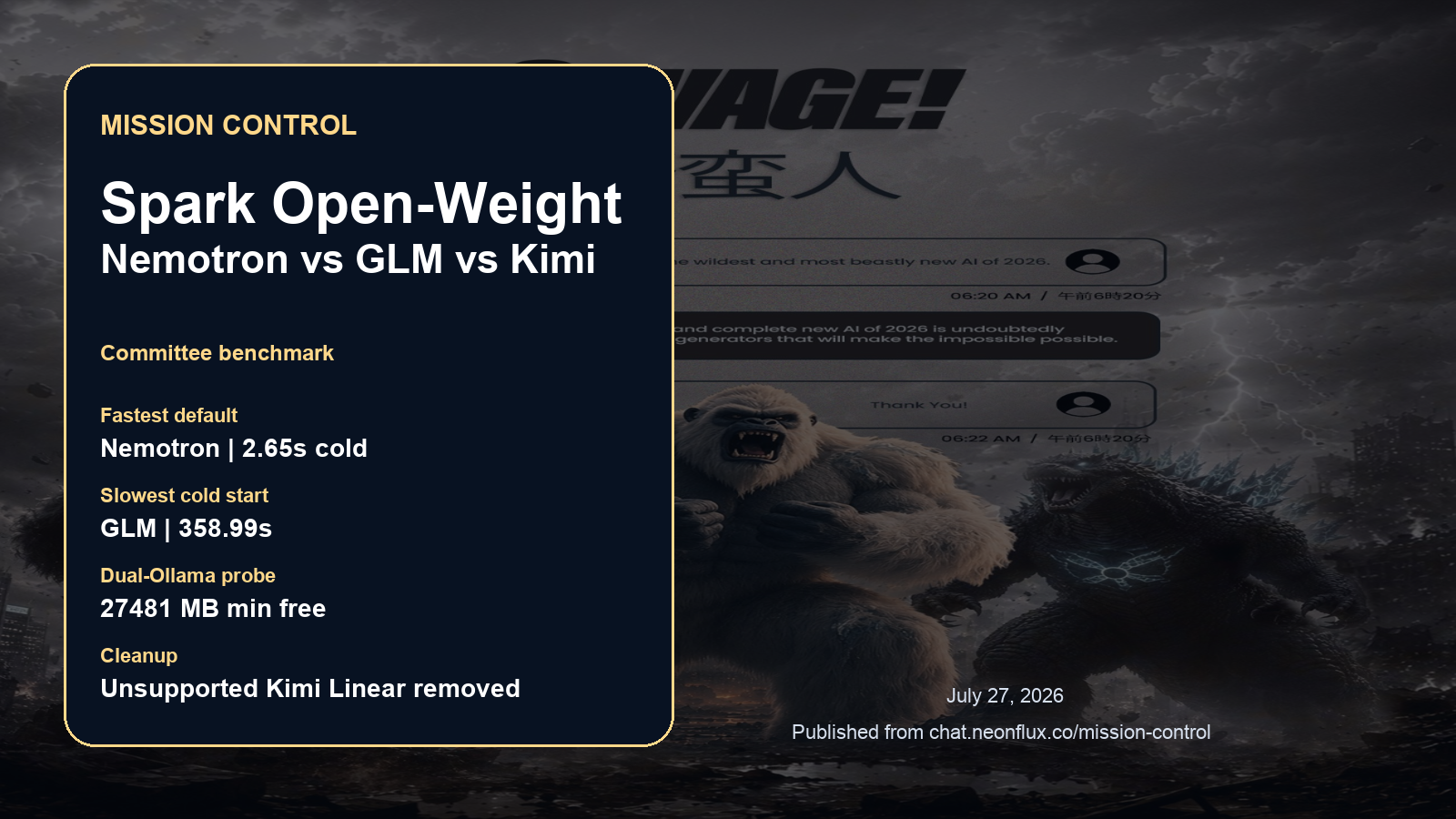
Mission Control Dispatch | Published July 27, 2026
Spark open-weight model bakeoff: Nemotron vs GLM vs Kimi
This was the first committee-grade Spark text comparison after removing the unsupported Kimi Linear image from the local catalog. We benchmarked three live open-weight text lanes on July 27, 2026: TensorRT-hosted Nemotron Super, Ollama-hosted GLM-4.5-Air Q6_K, and Ollama-hosted Kimi Dev 72B Q4_0. The result is clear enough to ship: Nemotron stays the public default, GLM earns the secondary comparison slot, and Kimi remains a slower specialty lane with lower concurrency expectations.
Fastest overall public lane and isolated from the shared Ollama contention path.
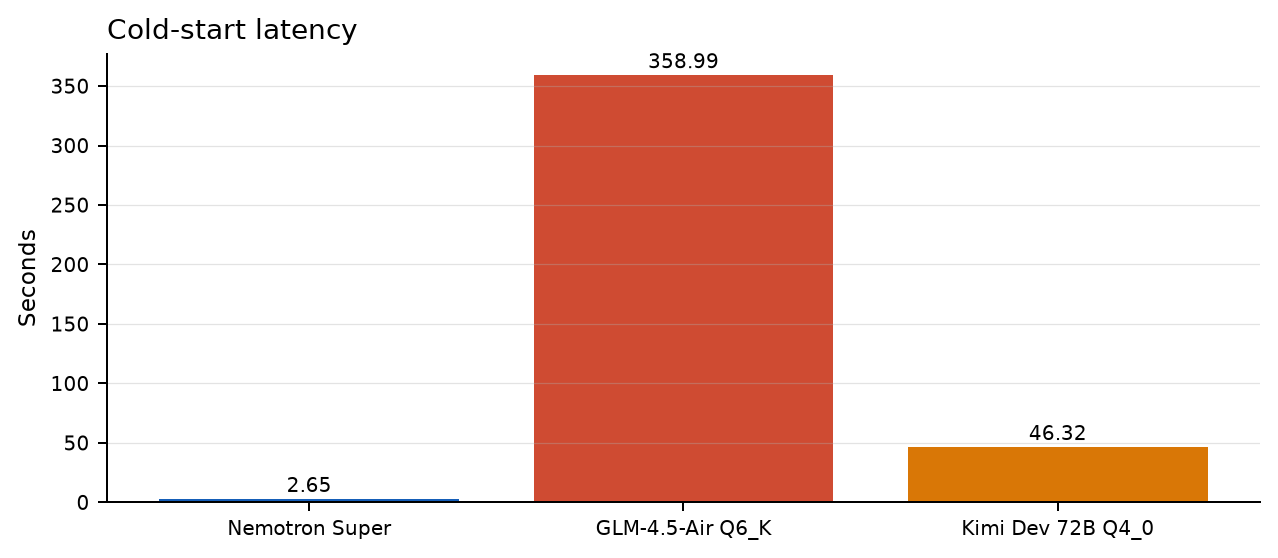
358.99 seconds on the measured warmup request.
The cold-load probe shows why GLM and Kimi should not be marketed as equivalent high-concurrency neighbors.
Kimi Linear was removed from Spark because the local Ollama runtime could not execute it.
Executive read
What the July 27 Spark bakeoff actually proved
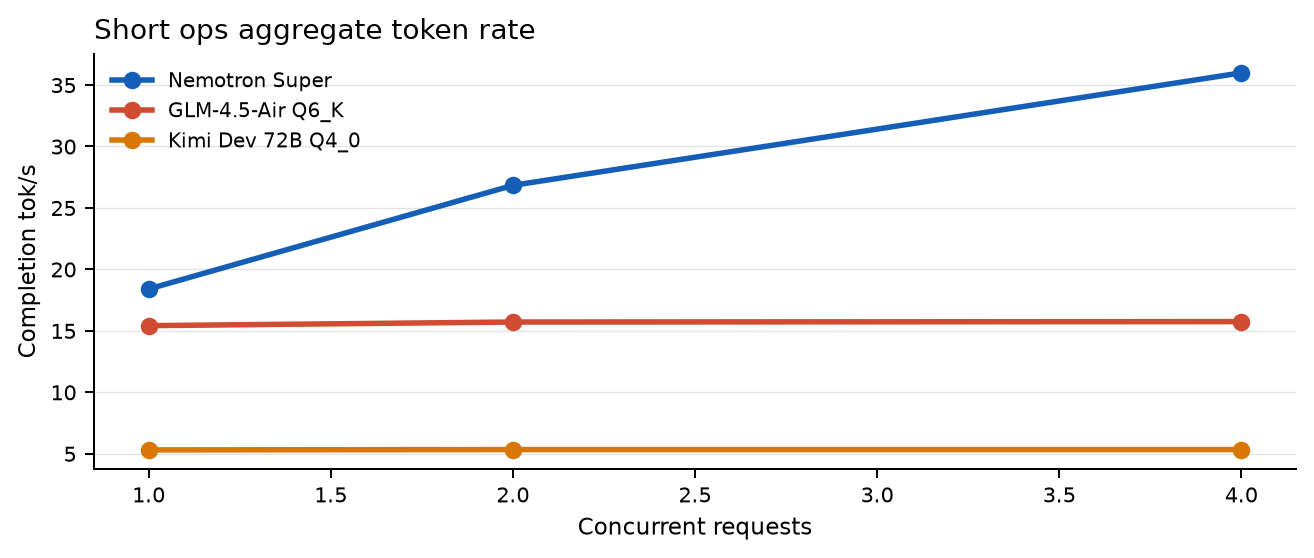
- Nemotron remains the right public default because it wins cold start and sustained speed without sharing the Ollama contention path.
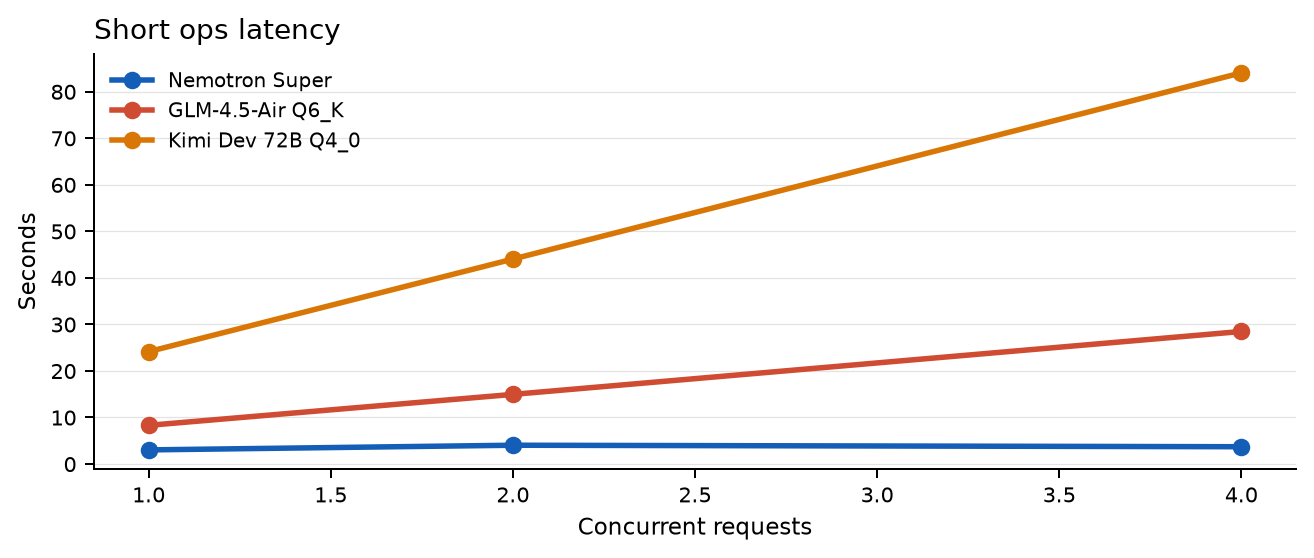
- GLM is the strongest secondary comparison lane on Spark, but its warmup behavior is too heavy to present as a drop-in equal to Nemotron.
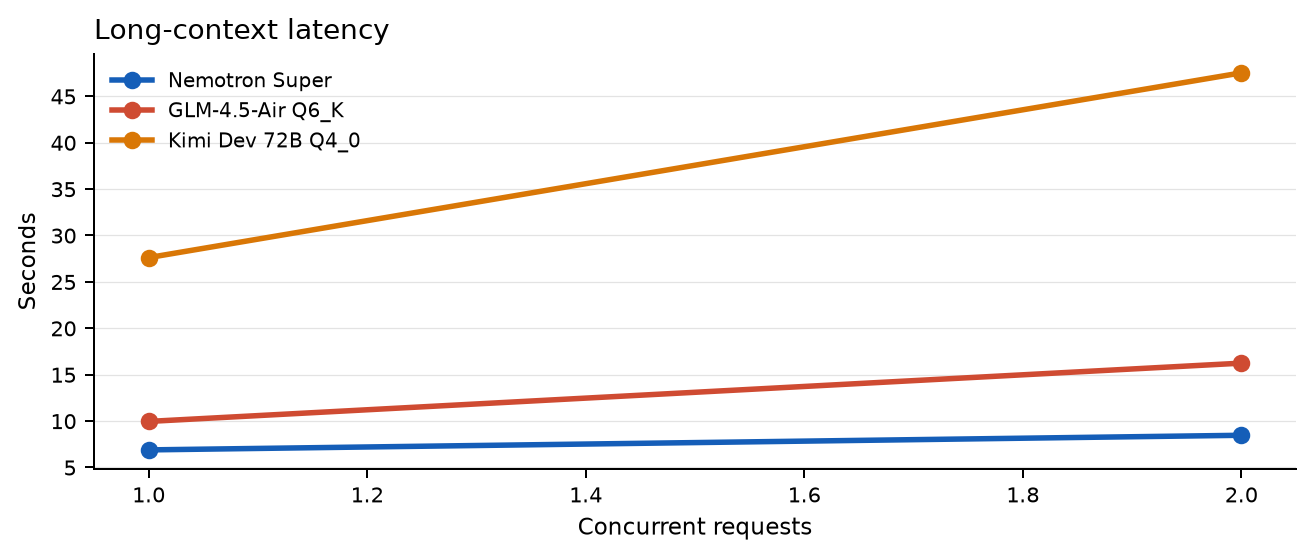
- Kimi stayed usable, but its latency curve and slower steady-state behavior make it a specialty model rather than a broad public default.
- The controlled dual-Ollama probe confirms that GLM and Kimi compete for the same memory headroom when asked to cold-load together.
- Unsupported catalog entries matter operationally: removing Kimi Linear reclaimed 52 GB and kept the Spark catalog honest.
Method
How the comparison was run
Each model ran through the same three prompt families: a short ops reply, a strict JSON guardrail reply, and a longer context-synthesis task. The benchmark captured per-request latency, throughput, completion-token rates where available, sampled host memory headroom, swap usage, GPU temperature, and GPU power. After the serial per-model sweep, Spark ran a separate dual-Ollama cold-load probe that launched GLM and Kimi together to expose real shared-lane pressure.
Live-stack note. The first co-resident GLM attempt on 2026-07-27T19:04:26Z failed with CUDA error: out of memory while TRT services were resident. The GLM and Kimi ladders published here were therefore rerun in an isolated Ollama window after the TRT services were temporarily stopped.
Post-run validation note. A live probe on Monday, July 27, 2026 between 20:10 UTC and 20:13 UTC showed Qwen restored on port 8000, but the Nemotron service had not yet opened port 8001 and both Ollama comparison lanes returned memory-pressure failures under the resident stack. GLM reported that it needed 83.6 GiB while only 15.9 GiB was available, and Kimi reported that it needed 69.2 GiB while only 15.8 GiB was available. The comparison data below remains valid because it was collected in the controlled benchmark windows described above, but the resident production stack should not present GLM and Kimi as always-on peers without queueing or a larger memory budget.
Cold starts and throughput
Nemotron still owns the default lane
Latency curves
GLM is the second lane, Kimi is the specialty lane
Memory headroom
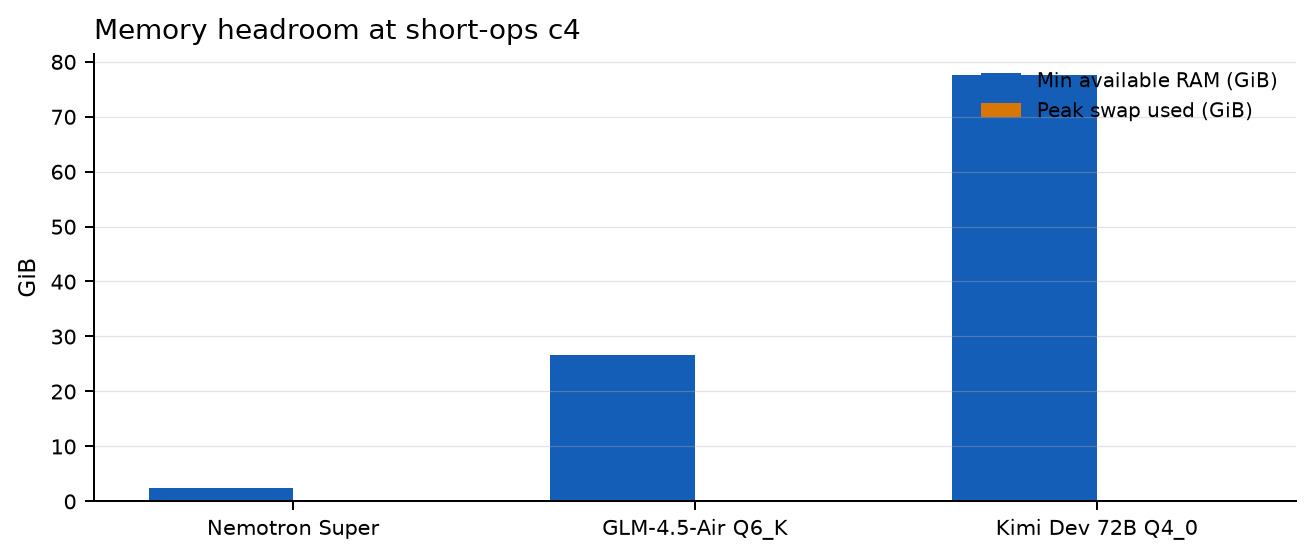
The shared Ollama lane is the real operational constraint
The biggest systems story was not GPU temperature. It was memory headroom. Even before the deliberate dual-Ollama probe, Spark showed tight free-memory behavior during the heavier Ollama phases. The controlled GLM-plus-Kimi cold-load check pushed the box down to 27481 MB of available RAM with n/a MB of swap consumed. That is why Mission Control is ranking GLM as the secondary lane and Kimi as a specialty lane instead of presenting both as interchangeable public defaults.
Tables
Short ops benchmark table
| Model | Concurrency | Avg latency s | P95 s | Throughput rps | Agg tok/s | Min avail MB | Peak swap MB |
|---|---|---|---|---|---|---|---|
| Nemotron Super | 1 | 3.02 | 3.32 | 0.330 | 18.40 | 2402 | n/a |
| Nemotron Super | 2 | 4.03 | 5.39 | 0.475 | 26.83 | 2364 | n/a |
| Nemotron Super | 4 | 3.70 | 6.53 | 0.929 | 35.98 | 2380 | n/a |
| GLM-4.5-Air Q6_K | 1 | 8.30 | 8.38 | 0.120 | 15.42 | 27243 | n/a |
| GLM-4.5-Air Q6_K | 2 | 14.95 | 16.38 | 0.123 | 15.71 | 27263 | n/a |
| GLM-4.5-Air Q6_K | 4 | 28.47 | 32.60 | 0.123 | 15.74 | 27189 | n/a |
| Kimi Dev 72B Q4_0 | 1 | 24.13 | 24.22 | 0.041 | 5.31 | 79178 | n/a |
| Kimi Dev 72B Q4_0 | 2 | 44.02 | 48.13 | 0.042 | 5.33 | 79441 | n/a |
| Kimi Dev 72B Q4_0 | 4 | 84.04 | 96.10 | 0.042 | 5.33 | 79393 | n/a |
Tables
Long context benchmark table
| Model | Concurrency | Avg latency s | P95 s | Throughput rps | Agg tok/s | Min avail MB | Peak swap MB |
|---|---|---|---|---|---|---|---|
| Nemotron Super | 1 | 6.89 | 6.97 | 0.145 | 20.91 | 2362 | n/a |
| Nemotron Super | 2 | 8.46 | 8.66 | 0.236 | 34.03 | 2310 | n/a |
| GLM-4.5-Air Q6_K | 1 | 9.96 | 11.39 | 0.100 | 14.46 | 27038 | n/a |
| GLM-4.5-Air Q6_K | 2 | 16.24 | 18.59 | 0.108 | 15.49 | 27089 | n/a |
| Kimi Dev 72B Q4_0 | 1 | 27.61 | 28.42 | 0.036 | 5.22 | 79136 | n/a |
| Kimi Dev 72B Q4_0 | 2 | 47.52 | 54.34 | 0.037 | 5.30 | 79373 | n/a |
Operator guidance
What should be live on Yeti Claw now
- Default public text lane: Nemotron Super.
- Secondary comparison lane: GLM-4.5-Air Q6_K.
- Specialty lane: Kimi Dev 72B Q4_0 with explicit lower concurrency expectations.
- Do not restore: Kimi Linear, because the local Ollama runtime still cannot execute that architecture.
- What the dual probe means: avoid marketing GLM and Kimi as parallel heavy lanes on the same box without queueing and clearer guardrails.